
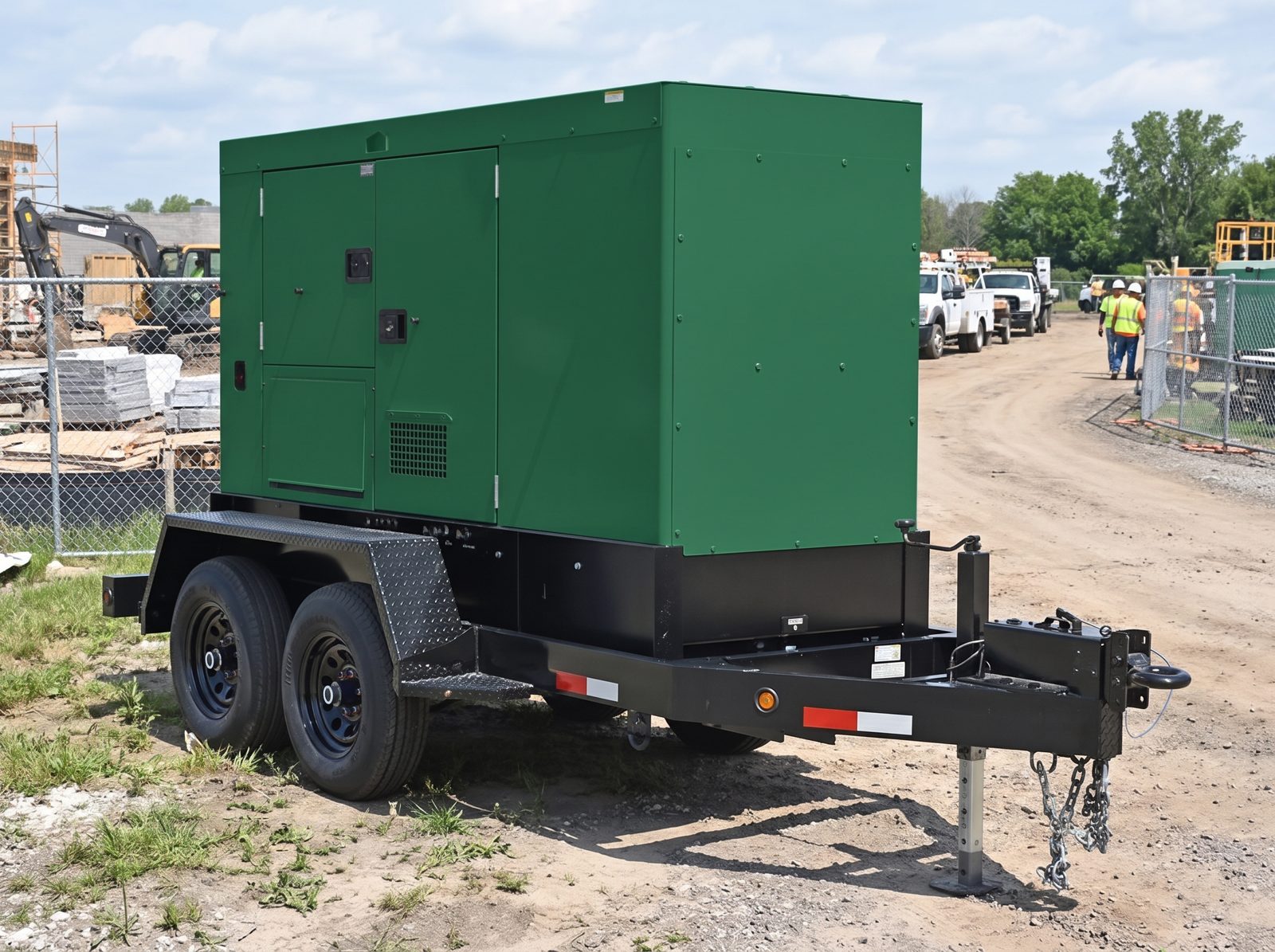
Portable generators for construction sites
A job-site generator has to start motors, run for a full shift and survive being moved around. These are the portable and towable models in our catalog that fit that work, with the output, fuel and price for each.
What to look for
Motor loads decide the size
Saws, compressors, pumps and concrete vibrators draw several times their running watts for a moment when they start. Size to the biggest starting load, then add everything else that runs at the same time.
Outlets matter as much as watts
Look for 120/240 V output, a 30 or 50 amp outlet for larger tools or a feeder, and ground-fault (GFCI) protection. Temporary power on construction sites is generally required to be ground-fault protected, so confirm with your site safety lead.
Fuel and runtime
Gasoline units are the least expensive to buy. Diesel units and dual-fuel units suit long days and remote sites. Check the tank size and run time at half load, not just full load.
Portable or towable
Past about 10 to 18 kW, a trailer-mounted diesel set is easier to move and refuel than a large portable, and it can power a trailer office, a light tower or a whole crew's tools.
Portable job-site generators (5 kW and up)
Open-frame and inverter units that one or two people can move. Honda, Generac, Briggs & Stratton and Cummins Onan in our catalog.
6 brands. Tap a brand to see its models.
New$4,689
List or retailUsed$1,780
Used price range, 501 to 1,000 hrs$1,350$2,250- Output
- 5 kW
- Fuel
- Diesel
- Voltage
- 120/240V
New$1,179
List or retailUsed$450
Used price range, 501 to 1,000 hrs$340$565- Output
- 5.2 kW
- Fuel
- Gasoline/LP
- Voltage
- 120/240V
New$1,269
List or retailUsed$480
Used price range, 501 to 1,000 hrs$360$600- Output
- 5.2 kW
- Fuel
- Gasoline/LP
- Voltage
- 120/240V
New$1,219
List or retailUsed$460
Used price range, 501 to 1,000 hrs$345$575- Output
- 5.5 kW
- Fuel
- Gasoline
- Voltage
- 120/240V
New$939
List or retailUsed$360
Used price range, 501 to 1,000 hrs$270$450- Output
- 6.5 kW
- Fuel
- Gasoline
- Voltage
- 120/240V
New$979
List or retailUsed$370
Used price range, 501 to 1,000 hrs$280$465- Output
- 6.5 kW
- Fuel
- Gasoline
- Voltage
- 120/240V
New$999
List or retailUsed$380
Used price range, 501 to 1,000 hrs$285$475- Output
- 6.5 kW
- Fuel
- Gasoline
- Voltage
- 120/240V
New$1,049
List or retailUsed$400
Used price range, 501 to 1,000 hrs$300$500- Output
- 7.5 kW
- Fuel
- Gasoline/LP
- Voltage
- 120/240V
New$1,159
List or retailUsed$440
Used price range, 501 to 1,000 hrs$330$550- Output
- 8 kW
- Fuel
- Gasoline
- Voltage
- 120/240V
New$1,179
List or retailUsed$450
Used price range, 501 to 1,000 hrs$340$565- Output
- 8 kW
- Fuel
- Gasoline
- Voltage
- 120/240V
New$1,429
List or retailUsed$540
Used price range, 501 to 1,000 hrs$405$675- Output
- 8 kW
- Fuel
- Gasoline
- Voltage
- 120/240V
New$1,289
List or retailUsed$490
Used price range, 501 to 1,000 hrs$370$615- Output
- 9.5 kW
- Fuel
- Gasoline/LP/NG
- Voltage
- 120/240V
New$1,539
List or retailUsed$580
Used price range, 501 to 1,000 hrs$435$725- Output
- 9.5 kW
- Fuel
- Gasoline/LP/NG
- Voltage
- 120/240V
New$4,649
List or retailUsed$1,770
Used price range, 501 to 1,000 hrs$1,350$2,200- Output
- 15.5 kW
- Fuel
- Gasoline
- Voltage
- 120/240V
New$4,399
List or retailUsed$1,670
Used price range, 501 to 1,000 hrs$1,250$2,100- Output
- 18 kW
- Fuel
- Gasoline
- Voltage
- 120/240V
New$4,800
List or retailUsed$2,500
Used price range, 501 to 1,000 hrs$1,900$3,150- Output
- 5 kW
- Fuel
- Gasoline
- Voltage
- 120/240V @ 60 Hz; 230V @ 180 Hz
New$2,910
List or retailUsed$1,510
Used price range, 501 to 1,000 hrs$1,150$1,900- Output
- 6 kW
- Fuel
- Gasoline
- Voltage
- 120/240V
New$3,050
List or retailUsed$1,590
Used price range, 501 to 1,000 hrs$1,200$2,000- Output
- 6 kW
- Fuel
- Gasoline
- Voltage
- 120/240V
New$5,395
List or retailUsed$2,800
Used price range, 501 to 1,000 hrs$2,100$3,500- Output
- 9.7 kW
- Fuel
- Gasoline
- Voltage
- 120/240V
New$13,340
List or retailUsed$7,500
Used price range, 501 to 1,000 hrs$5,650$9,400- Output
- 10.5 kW
- Fuel
- Diesel (Tier 4F)
- Voltage
- 120/240V 1Ø
New$16,313
List or retailUsed$9,100
Used price range, 501 to 1,000 hrs$6,850$11,400- Output
- 10.5 kW
- Fuel
- Diesel (Tier 4F)
- Voltage
- 120/240V 1Ø
New$20,934
List or retailUsed$11,700
Used price range, 501 to 1,000 hrs$8,800$14,600- Output
- 14 kW
- Fuel
- Diesel (Tier 4F)
- Voltage
- 120/240V 1Ø
New$26,500
GenTrak estimateUsed$14,800
Used price range, 501 to 1,000 hrs$11,100$18,500- Output
- 14 kW
- Fuel
- Diesel (Tier 4F)
- Voltage
- 120/240V 1Ø
New$960
GenTrak estimateUsed$360
Used price range, 501 to 1,000 hrs$270$450- Output
- 6.3 kW
- Fuel
- Gasoline
- Voltage
- 120/240V
New$1,020
GenTrak estimateUsed$390
Used price range, 501 to 1,000 hrs$295$490- Output
- 6.3 kW
- Fuel
- Gasoline
- Voltage
- 120/240V
New$1,368
List or retailUsed$520
Used price range, 501 to 1,000 hrs$390$650- Output
- 6.5 kW
- Fuel
- Gasoline
- Voltage
- 120/240V
New$1,050
GenTrak estimateUsed$400
Used price range, 501 to 1,000 hrs$300$500- Output
- 7.2 kW
- Fuel
- Gasoline
- Voltage
- 120/240V
New$1,110
GenTrak estimateUsed$420
Used price range, 501 to 1,000 hrs$315$525- Output
- 8.5 kW
- Fuel
- Gasoline
- Voltage
- 120/240V
New$1,197
List or retailUsed$450
Used price range, 501 to 1,000 hrs$340$565- Output
- 8.8 kW
- Fuel
- Gasoline
- Voltage
- 120/240V
New$1,292
List or retailUsed$490
Used price range, 501 to 1,000 hrs$370$615- Output
- 10 kW
- Fuel
- Gasoline
- Voltage
- 120/240V
New$4,583
List or retailUsed$2,400
Used price range, 501 to 1,000 hrs$1,800$3,000- Output
- 6 kW
- Fuel
- Gasoline (Honda GX390)
- Voltage
- 208, 240 or 480V 3Ø (per suffix)
New$6,000
GenTrak estimateUsed$3,400
Used price range, 501 to 1,000 hrs$2,550$4,250- Output
- 6.5 kW
- Fuel
- Diesel (Kohler)
- Voltage
- 120/240V 1Ø
New$6,000
GenTrak estimateUsed$3,400
Used price range, 501 to 1,000 hrs$2,550$4,250- Output
- 6.5 kW
- Fuel
- Diesel (Kohler)
- Voltage
- 120/240V 1Ø
New$8,800
GenTrak estimateUsed$4,900
Used price range, 501 to 1,000 hrs$3,700$6,150- Output
- 6.5 kW
- Fuel
- Diesel (Kohler)
- Voltage
- 208, 240 or 480V 3Ø (per suffix)
New$3,140
List or retailUsed$1,630
Used price range, 501 to 1,000 hrs$1,200$2,050- Output
- 7.5 kW
- Fuel
- Gasoline (Honda GX390)
- Voltage
- 120/240V 1Ø
New$4,700
GenTrak estimateUsed$2,400
Used price range, 501 to 1,000 hrs$1,800$3,000- Output
- 12.5 kW
- Fuel
- Gasoline (Honda)
- Voltage
- 120/240V 1Ø
New$6,900
GenTrak estimateUsed$3,600
Used price range, 501 to 1,000 hrs$2,700$4,500- Output
- 12.5 kW
- Fuel
- Gasoline (Honda)
- Voltage
- 208, 240 or 480V 3Ø (per suffix)
New$2,799
List or retailUsed$1,460
Used price range, 501 to 1,000 hrs$1,100$1,850- Output
- 5 kW
- Fuel
- Gasoline
- Voltage
- 120/240V
New$2,999
List or retailUsed$1,560
Used price range, 501 to 1,000 hrs$1,150$1,950- Output
- 5 kW
- Fuel
- Gasoline
- Voltage
- 120/240V
New$2,999
List or retailUsed$1,560
Used price range, 501 to 1,000 hrs$1,150$1,950- Output
- 6.5 kW
- Fuel
- Gasoline
- Voltage
- 120/240V
New$3,299
List or retailUsed$1,720
Used price range, 501 to 1,000 hrs$1,300$2,150- Output
- 6.5 kW
- Fuel
- Gasoline
- Voltage
- 120/240V
New$4,899
List or retailUsed$2,500
Used price range, 501 to 1,000 hrs$1,900$3,150- Output
- 7 kW
- Fuel
- Gasoline
- Voltage
- 120/240V
New$5,999
List or retailUsed$3,100
Used price range, 501 to 1,000 hrs$2,350$3,900- Output
- 10 kW
- Fuel
- Gasoline
- Voltage
- 120/240V
New$1,561
List or retailUsed$590
Used price range, 501 to 1,000 hrs$445$740- Output
- 5 kW
- Fuel
- Gasoline/LP
- Voltage
- 120V / 240V (verify)
New$1,700
List or retailUsed$650
Used price range, 501 to 1,000 hrs$490$815- Output
- 9.5 kW
- Fuel
- Gasoline/LP
- Voltage
- 120/240V
New$2,424
List or retailUsed$920
Used price range, 501 to 1,000 hrs$690$1,150- Output
- 11 kW
- Fuel
- Gasoline/LP/NG
- Voltage
- 120/240V

 GT Approved





Towable and mobile sets (up to 250 kW)
Trailer-mounted sets from Generac Mobile, Kohler (Rehlko) and Caterpillar for larger crews, trailers, site offices and whole job sites.
8 brands. Tap a brand to see its models.
New$10,500
GenTrak estimateUsed$5,900
Used price range, 501 to 1,000 hrs$4,450$7,400- Output
- 6 kW
- Fuel
- Diesel
- Voltage
- 120/240V 1Ø
New$11,700
GenTrak estimateUsed$6,600
Used price range, 501 to 1,000 hrs$4,950$8,250- Output
- 6 kW
- Fuel
- Diesel
- Voltage
- 208/220/240V 3Ø; 120/127/139V 1Ø
New$11,924
List or retailUsed$6,700
Used price range, 501 to 1,000 hrs$5,050$8,400- Output
- 6 kW
- Fuel
- Diesel
- Voltage
- 120/240V 1Ø
New$15,843
List or retailUsed$8,900
Used price range, 501 to 1,000 hrs$6,700$11,100- Output
- 10 kW
- Fuel
- Diesel
- Voltage
- 120/240V 1Ø
New$20,300
GenTrak estimateUsed$11,400
Used price range, 501 to 1,000 hrs$8,550$14,300- Output
- 14 kW
- Fuel
- Diesel
- Voltage
- 120/240V 1Ø
New$26,300
GenTrak estimateUsed$16,600
Used price range, 501 to 1,000 hrs$12,500$20,800- Output
- 20 kW
- Fuel
- Diesel
- Voltage
- 120/240V 1Ø
New$27,711
List or retailUsed$17,500
Used price range, 501 to 1,000 hrs$13,100$21,900- Output
- 20 kW
- Fuel
- Diesel
- Voltage
- Selectable 120/240 1Ø; 120/208, 277/480 3Ø
New$34,500
GenTrak estimateUsed$21,500
Used price range, 501 to 1,000 hrs$16,100$26,900- Output
- 29 kW
- Fuel
- Diesel
- Voltage
- Selectable 120/240 1Ø; 120/208, 277/480 3Ø
New$39,018
List or retailUsed$24,500
Used price range, 501 to 1,000 hrs$18,400$30,600- Output
- 36 kW
- Fuel
- Diesel
- Voltage
- Selectable 120/240 1Ø; 120/208, 277/480 3Ø
New$40,485
List or retailUsed$25,500
Used price range, 501 to 1,000 hrs$19,100$31,900- Output
- 36 kW
- Fuel
- Diesel
- Voltage
- 120/240V 1Ø
New$51,000
GenTrak estimateUsed$32,000
Used price range, 501 to 1,000 hrs$24,000$40,000- Output
- 56 kW
- Fuel
- Diesel
- Voltage
- Selectable 120/240 1Ø; 120/208, 277/480 3Ø
New$51,000
GenTrak estimateUsed$32,000
Used price range, 501 to 1,000 hrs$24,000$40,000- Output
- 56 kW
- Fuel
- Diesel
- Voltage
- Selectable 120/240 1Ø; 120/208, 277/480 3Ø
New$72,000
GenTrak estimateUsed$45,500
Used price range, 501 to 1,000 hrs$34,100$56,900- Output
- 100 kW
- Fuel
- Diesel
- Voltage
- Selectable 120/240 1Ø; 120/208, 277/480 3Ø
New$80,500
GenTrak estimateUsed$50,500
Used price range, 501 to 1,000 hrs$37,900$63,100- Output
- 120 kW
- Fuel
- Diesel
- Voltage
- Selectable 120/240 1Ø; 120/208, 277/480 3Ø
New$89,500
GenTrak estimateUsed$56,500
Used price range, 501 to 1,000 hrs$42,400$70,600- Output
- 144 kW
- Fuel
- Diesel
- Voltage
- Selectable 120/240 1Ø; 120/208, 277/480 3Ø
New$128,000
GenTrak estimateUsed$80,500
Used price range, 501 to 1,000 hrs$60,400$100,600- Output
- 168 kW
- Fuel
- Diesel
- Voltage
- 120/208V 3Ø; 277/480V 3Ø; 120/240V 1Ø
New$101,000
GenTrak estimateUsed$63,500
Used price range, 501 to 1,000 hrs$47,600$79,400- Output
- 176 kW
- Fuel
- Diesel
- Voltage
- Selectable 120/240 1Ø; 120/208, 277/480 3Ø
New$138,500
GenTrak estimateUsed$87,500
Used price range, 501 to 1,000 hrs$65,600$109,400- Output
- 192 kW
- Fuel
- Diesel
- Voltage
- 120/208V 3Ø; 277/480V 3Ø; 120/240V 1Ø
New$122,000
GenTrak estimateUsed$77,000
Used price range, 501 to 1,000 hrs$57,800$96,300- Output
- 240 kW
- Fuel
- Diesel
- Voltage
- 208–480V 3Ø; 120–277V 1Ø (reconnectable)
New$21,500
GenTrak estimateUsed$13,500
Used price range, 501 to 1,000 hrs$10,100$16,900- Output
- 16 kW
- Fuel
- Diesel
- Voltage
- 220 – 415 V
New$35,500
GenTrak estimateUsed$22,500
Used price range, 501 to 1,000 hrs$16,900$28,100- Output
- 16 kW
- Fuel
- Diesel
- Voltage
- 208 – 480 V
New$24,500
GenTrak estimateUsed$15,400
Used price range, 501 to 1,000 hrs$11,600$19,300- Output
- 24 kW
- Fuel
- Diesel
- Voltage
- 127 – 480 V
New$42,000
GenTrak estimateUsed$26,500
Used price range, 501 to 1,000 hrs$19,900$33,100- Output
- 27 kW
- Fuel
- Diesel
- Voltage
- 120 – 600 V
New$55,000
GenTrak estimateUsed$34,500
Used price range, 501 to 1,000 hrs$25,900$43,100- Output
- 46 kW
- Fuel
- Diesel
- Voltage
- 120 – 480 V
New$34,000
GenTrak estimateUsed$21,500
Used price range, 501 to 1,000 hrs$16,100$26,900- Output
- 48 kW
- Fuel
- Diesel
- Voltage
- 127 – 480 V
New$34,000
GenTrak estimateUsed$21,500
Used price range, 501 to 1,000 hrs$16,100$26,900- Output
- 48 kW
- Fuel
- Diesel
- Voltage
- 220 – 480 V
New$52,000
GenTrak estimateUsed$33,000
Used price range, 501 to 1,000 hrs$24,800$41,300- Output
- 80 kW
- Fuel
- Diesel
- Voltage
- 127 – 480 V
New$59,500
GenTrak estimateUsed$37,500
Used price range, 501 to 1,000 hrs$28,100$46,900- Output
- 92 kW
- Fuel
- Diesel
- Voltage
- 220 – 480 V
New$102,500
List or retailUsed$64,500
Used price range, 501 to 1,000 hrs$48,400$80,600- Output
- 100 kW
- Fuel
- Diesel
- Voltage
- 120 – 600 V
New$70,500
GenTrak estimateUsed$44,500
Used price range, 501 to 1,000 hrs$33,400$55,600- Output
- 120 kW
- Fuel
- Diesel
- Voltage
- 127 – 480 V
New$86,500
GenTrak estimateUsed$54,500
Used price range, 501 to 1,000 hrs$40,900$68,100- Output
- 160 kW
- Fuel
- Diesel
- Voltage
- 220 – 480 V
New$156,000
GenTrak estimateUsed$98,500
Used price range, 501 to 1,000 hrs$73,900$123,100- Output
- 182 kW
- Fuel
- Diesel
- Voltage
- 120 – 600 V
New$115,500
GenTrak estimateUsed$73,000
Used price range, 501 to 1,000 hrs$54,800$91,300- Output
- 240 kW
- Fuel
- Diesel
- Voltage
- 127 – 480 V
New$118,000
GenTrak estimateUsed$74,500
Used price range, 501 to 1,000 hrs$55,900$93,100- Output
- 248 kW
- Fuel
- Diesel
- Voltage
- 220 – 480 V
New$17,500
GenTrak estimateUsed$9,400
Used price range, 501 to 1,000 hrs$7,050$11,800- Output
- 20 kW
- Fuel
- LPG
- Voltage
- 120/240V 1Ø
New$17,500
GenTrak estimateUsed$9,400
Used price range, 501 to 1,000 hrs$7,050$11,800- Output
- 20 kW
- Fuel
- Natural gas
- Voltage
- 120/240V 1Ø
New$29,000
GenTrak estimateUsed$18,500
Used price range, 501 to 1,000 hrs$13,900$23,100- Output
- 20 kW
- Fuel
- Diesel (Tier 4F)
- Voltage
- 3Ø reconnectable (120/208 – 480V)
New$20,600
GenTrak estimateUsed$11,100
Used price range, 501 to 1,000 hrs$8,350$13,900- Output
- 25 kW
- Fuel
- LPG
- Voltage
- 3Ø reconnectable (120/208 – 480V)
New$20,600
GenTrak estimateUsed$11,100
Used price range, 501 to 1,000 hrs$8,350$13,900- Output
- 25 kW
- Fuel
- Natural gas
- Voltage
- 3Ø reconnectable (120/208 – 480V)
New$22,600
GenTrak estimateUsed$12,200
Used price range, 501 to 1,000 hrs$9,150$15,300- Output
- 28 kW
- Fuel
- Natural gas
- Voltage
- 120/240V 1Ø
New$22,600
GenTrak estimateUsed$12,200
Used price range, 501 to 1,000 hrs$9,150$15,300- Output
- 29 kW
- Fuel
- LPG
- Voltage
- 120/240V 1Ø
New$27,300
GenTrak estimateUsed$14,700
Used price range, 501 to 1,000 hrs$11,000$18,400- Output
- 36 kW
- Fuel
- LPG
- Voltage
- 3Ø reconnectable (120/208 – 480V)
New$27,300
GenTrak estimateUsed$14,700
Used price range, 501 to 1,000 hrs$11,000$18,400- Output
- 36 kW
- Fuel
- Natural gas
- Voltage
- 3Ø reconnectable (120/208 – 480V)
New$37,500
GenTrak estimateUsed$23,500
Used price range, 501 to 1,000 hrs$17,600$29,400- Output
- 36 kW
- Fuel
- Diesel (Tier 4F)
- Voltage
- 3Ø reconnectable (120/208 – 480V)
New$47,000
GenTrak estimateUsed$29,500
Used price range, 501 to 1,000 hrs$22,100$36,900- Output
- 56 kW
- Fuel
- Diesel (Tier 4F)
- Voltage
- 3Ø reconnectable (120/208 – 480V)
New$78,000
GenTrak estimateUsed$49,000
Used price range, 501 to 1,000 hrs$36,800$61,300- Output
- 100 kW
- Fuel
- Diesel (Tier 4F)
- Voltage
- 3Ø reconnectable (120/208 – 480V)
New$104,000
GenTrak estimateUsed$65,500
Used price range, 501 to 1,000 hrs$49,100$81,900- Output
- 152 kW
- Fuel
- Diesel (Tier 4F)
- Voltage
- 3Ø reconnectable (120/208 – 480V)
New$123,500
GenTrak estimateUsed$78,000
Used price range, 501 to 1,000 hrs$58,500$97,500- Output
- 192 kW
- Fuel
- Diesel (Tier 4F)
- Voltage
- 3Ø reconnectable (120/208 – 480V)
New$13,509
List or retailUsed$8,500
Used price range, 501 to 1,000 hrs$6,400$10,600- Output
- 8.1 kW
- Fuel
- Diesel
- Voltage
- 120/240V 1Ø
New$18,100
GenTrak estimateUsed$11,400
Used price range, 501 to 1,000 hrs$8,550$14,300- Output
- 13 kW
- Fuel
- Diesel
- Voltage
- 120/240V 1Ø
New$23,374
List or retailUsed$14,700
Used price range, 501 to 1,000 hrs$11,000$18,400- Output
- 16 kW
- Fuel
- Diesel
- Voltage
- 120/240V 1Ø
New$20,500
GenTrak estimateUsed$12,900
Used price range, 501 to 1,000 hrs$9,700$16,100- Output
- 20 kW
- Fuel
- Diesel
- Voltage
- Selectable 120/240 1Ø; 120/208, 277/480 3Ø
New$27,000
GenTrak estimateUsed$17,000
Used price range, 501 to 1,000 hrs$12,800$21,300- Output
- 38 kW
- Fuel
- Diesel
- Voltage
- Selectable 120/240 1Ø; 120/208, 277/480 3Ø
New$35,500
GenTrak estimateUsed$22,500
Used price range, 501 to 1,000 hrs$16,900$28,100- Output
- 60 kW
- Fuel
- Diesel
- Voltage
- Selectable 120/240 1Ø; 120/208, 277/480 3Ø
New$46,500
GenTrak estimateUsed$29,500
Used price range, 501 to 1,000 hrs$22,100$36,900- Output
- 80 kW
- Fuel
- Diesel
- Voltage
- Selectable 120/240 1Ø; 120/208, 277/480 3Ø
New$63,000
GenTrak estimateUsed$39,500
Used price range, 501 to 1,000 hrs$29,600$49,400- Output
- 120 kW
- Fuel
- Diesel
- Voltage
- Selectable 120/240 1Ø; 120/208, 277/480 3Ø
New$70,000
GenTrak estimateUsed$44,000
Used price range, 501 to 1,000 hrs$33,000$55,000- Output
- 140 kW
- Fuel
- Diesel
- Voltage
- Selectable 120/208, 240, 277/480 3Ø
New$95,500
GenTrak estimateUsed$55,500
Used price range, 501 to 1,000 hrs$41,600$69,400- Output
- 185 kW
- Fuel
- Natural gas/LP
- Voltage
- Selectable 3Ø (verify spec sheet)
New$91,000
GenTrak estimateUsed$57,500
Used price range, 501 to 1,000 hrs$43,100$71,900- Output
- 200 kW
- Fuel
- Diesel
- Voltage
- Selectable 120/208, 240, 277/480 3Ø
New$120,500
GenTrak estimateUsed$70,000
Used price range, 501 to 1,000 hrs$52,500$87,500- Output
- 237 kW
- Fuel
- Natural gas/LP
- Voltage
- Selectable 3Ø (verify spec sheet)
New$34,500
GenTrak estimateUsed$21,500
Used price range, 501 to 1,000 hrs$16,100$26,900- Output
- 20 kW
- Fuel
- Diesel (Tier 4F)
- Voltage
- Selectable 120/240 1Ø; 120/208, 277/480 3Ø
New$46,900
List or retailUsed$29,500
Used price range, 501 to 1,000 hrs$22,100$36,900- Output
- 32 kW
- Fuel
- Diesel (Tier 4F)
- Voltage
- Selectable 120/240 1Ø; 120/208, 277/480 3Ø
New$53,500
GenTrak estimateUsed$33,500
Used price range, 501 to 1,000 hrs$25,100$41,900- Output
- 40 kW
- Fuel
- Diesel (Tier 4F)
- Voltage
- Selectable 120/240 1Ø; 120/208, 277/480 3Ø
New$65,500
GenTrak estimateUsed$41,500
Used price range, 501 to 1,000 hrs$31,100$51,900- Output
- 56 kW
- Fuel
- Diesel (Tier 4F)
- Voltage
- Selectable 120/240 1Ø; 120/208, 277/480 3Ø
New$81,500
GenTrak estimateUsed$51,500
Used price range, 501 to 1,000 hrs$38,600$64,400- Output
- 80 kW
- Fuel
- Diesel (Tier 4F)
- Voltage
- Selectable 120/240 1Ø; 120/208, 277/480 3Ø
New$93,000
GenTrak estimateUsed$58,500
Used price range, 501 to 1,000 hrs$43,900$73,100- Output
- 100 kW
- Fuel
- Diesel (Tier 4F)
- Voltage
- Selectable 120/240 1Ø; 120/208, 277/480 3Ø
New$105,000
GenTrak estimateUsed$66,000
Used price range, 501 to 1,000 hrs$49,500$82,500- Output
- 123 kW
- Fuel
- Diesel (Tier 4F)
- Voltage
- Selectable 120/240 1Ø; 120/208, 277/480 3Ø
New$116,000
GenTrak estimateUsed$73,000
Used price range, 501 to 1,000 hrs$54,800$91,300- Output
- 145 kW
- Fuel
- Diesel (Tier 4F)
- Voltage
- Selectable 120/240 1Ø; 120/208, 277/480 3Ø
New$136,000
GenTrak estimateUsed$85,500
Used price range, 501 to 1,000 hrs$64,100$106,900- Output
- 189 kW
- Fuel
- Diesel (Tier 4F)
- Voltage
- Selectable 3Ø (208–480V)
New$39,500
GenTrak estimateUsed$25,000
Used price range, 501 to 1,000 hrs$18,800$31,300- Output
- 40 kW
- Fuel
- Diesel (Tier 4F)
- Voltage
- Configurable: 120/240 1Ø; 120/208, 120/240, 277/480, 347/600 3Ø
New$48,000
GenTrak estimateUsed$30,000
Used price range, 501 to 1,000 hrs$22,500$37,500- Output
- 60 kW
- Fuel
- Diesel (Tier 4F)
- Voltage
- Configurable: 120/240 1Ø; 120/208, 120/240, 277/480, 347/600 3Ø
New$62,500
GenTrak estimateUsed$39,500
Used price range, 501 to 1,000 hrs$29,600$49,400- Output
- 80 kW
- Fuel
- Diesel (Tier 4F)
- Voltage
- Configurable: 120/240 1Ø; 120/208, 120/240, 277/480, 347/600 3Ø
New$77,000
GenTrak estimateUsed$48,500
Used price range, 501 to 1,000 hrs$36,400$60,600- Output
- 100 kW
- Fuel
- Diesel (Tier 4F)
- Voltage
- Configurable: 120/240 1Ø; 120/208, 120/240, 277/480, 347/600 3Ø
New$89,500
GenTrak estimateUsed$56,500
Used price range, 501 to 1,000 hrs$42,400$70,600- Output
- 125 kW
- Fuel
- Diesel (Tier 4F)
- Voltage
- Configurable: 120/240 1Ø; 120/208, 120/240, 277/480, 347/600 3Ø
New$101,000
GenTrak estimateUsed$63,500
Used price range, 501 to 1,000 hrs$47,600$79,400- Output
- 150 kW
- Fuel
- Diesel (Tier 4F)
- Voltage
- Configurable: 120/240 1Ø; 120/208, 120/240, 277/480, 347/600 3Ø
New$125,000
GenTrak estimateUsed$79,000
Used price range, 501 to 1,000 hrs$59,300$98,800- Output
- 200 kW
- Fuel
- Diesel (Tier 4F)
- Voltage
- Configurable 3Ø: 120/208, 277/480, 347/600
New$146,000
GenTrak estimateUsed$92,000
Used price range, 501 to 1,000 hrs$69,000$115,000- Output
- 250 kW
- Fuel
- Diesel (Tier 4F)
- Voltage
- Configurable 3Ø: 120/208, 277/480, 347/600
New$31,500
GenTrak estimateUsed$20,000
Used price range, 501 to 1,000 hrs$15,000$25,000- Output
- 25 kW
- Fuel
- Diesel (Tier 4F)
- Voltage
- Configurable: 120/240 1Ø; 120/208, 120/240, 277/480, 347/600 3Ø
New$44,000
GenTrak estimateUsed$27,500
Used price range, 501 to 1,000 hrs$20,600$34,400- Output
- 50 kW
- Fuel
- Diesel (Tier 4F)
- Voltage
- Configurable: 120/240 1Ø; 120/208, 120/240, 277/480, 347/600 3Ø
New$65,000
GenTrak estimateUsed$41,000
Used price range, 501 to 1,000 hrs$30,800$51,300- Output
- 80 kW
- Fuel
- Diesel (Tier 4F)
- Voltage
- Configurable: 120/240 1Ø; 120/208, 120/240, 277/480, 347/600 3Ø
New$93,000
GenTrak estimateUsed$58,500
Used price range, 501 to 1,000 hrs$43,900$73,100- Output
- 130 kW
- Fuel
- Diesel (Tier 4F)
- Voltage
- Configurable: 120/240 1Ø; 120/208, 120/240, 277/480, 347/600 3Ø
New$113,000
GenTrak estimateUsed$71,000
Used price range, 501 to 1,000 hrs$53,300$88,800- Output
- 170 kW
- Fuel
- Diesel (Tier 4F)
- Voltage
- Configurable 3Ø: 120/208, 277/480, 347/600
New$138,000
GenTrak estimateUsed$87,000
Used price range, 501 to 1,000 hrs$65,300$108,800- Output
- 225 kW
- Fuel
- Diesel (Tier 4F)
- Voltage
- Configurable 3Ø: 120/208, 277/480, 347/600
New$50,500
GenTrak estimateUsed$32,000
Used price range, 501 to 1,000 hrs$24,000$40,000- Output
- 85 kW
- Fuel
- Diesel
- Voltage
- Selectable 1Ø/3Ø: 120/240, 120/208, 277/480V (verify spec sheet)
New$60,500
GenTrak estimateUsed$38,000
Used price range, 501 to 1,000 hrs$28,500$47,500- Output
- 105 kW
- Fuel
- Diesel
- Voltage
- Selectable 1Ø/3Ø: 120/240, 120/208, 277/480V (verify spec sheet)
New$70,000
GenTrak estimateUsed$44,000
Used price range, 501 to 1,000 hrs$33,000$55,000- Output
- 130 kW
- Fuel
- Diesel
- Voltage
- Selectable 1Ø/3Ø: 120/240, 120/208, 277/480V (verify spec sheet)
New$77,000
GenTrak estimateUsed$48,500
Used price range, 501 to 1,000 hrs$36,400$60,600- Output
- 150 kW
- Fuel
- Diesel
- Voltage
- Selectable 1Ø/3Ø: 120/240, 120/208, 277/480V (verify spec sheet)






Prices are list or retail where a maker publishes one, and GenTrak estimates of fair market value where it does not. Data as of November 8, 2026. Each model page shows where to buy and used values.

A quick way to size a job-site generator
- List every tool and light that can run at the same time, with its running watts (on the nameplate).
- Find the single biggest starting load, such as a compressor or a pump. Motors can need two to three times their running watts to start.
- Add the running watts of the other loads to the starting watts of that one biggest load. That is the minimum the generator needs.
- Leave about 20 to 25 percent headroom so the generator is not running flat out all day.
- Pick a generator whose rated (running) output covers that number, not just its peak or starting rating.
Checklist before you buy
- GFCI-protected outlets, or an in-line GFCI
- 120/240 V with the outlet types your tools use
- Wheel kit or trailer for moving it
- Low-oil shutoff and a spark arrestor where required
- Run time on a full tank at half load
- A dealer or service network near your site
Frequently asked questions
What size generator do I need for a construction site?
Add up the running watts of the tools that run together, then add the starting watts of the one biggest motor, and leave 20 to 25 percent headroom. A small crew with hand tools is often fine on 5 to 8 kW. Air compressors, welders and several saws at once can push you to 10 kW and up, or to a towable diesel set.
Is a gasoline or diesel generator better for a job site?
Gasoline portables cost less up front and are easy to move. Diesel sets are more fuel efficient under steady load and usually run longer between fills, which suits long shifts and larger towable units. Dual-fuel models add propane as a backup.
Can I run a welder or air compressor on a portable generator?
Often yes, but check the equipment's nameplate. Welders and compressors have large starting or peak draws, so the generator's rated output needs to cover them with headroom. If the tool maker lists a minimum generator size, follow it.
Do job-site generators need GFCI protection?
Temporary power on construction sites is generally required to have ground-fault protection, either built into the generator's receptacles or added with a GFCI adapter or panel. Rules vary by site and by jurisdiction, so check with your safety officer or the authority having jurisdiction.
Keep going
- Diesel generators, 10 to 25 kWCompare towable and standby diesel sets
- Generator size calculatorAdd up your loads and get a size
- Freight estimatorEstimate the cost to ship a larger unit
Other portable generator guides: Mobile and RV power, Emergency and home backup, Portable vs standby power, Inverter generators.